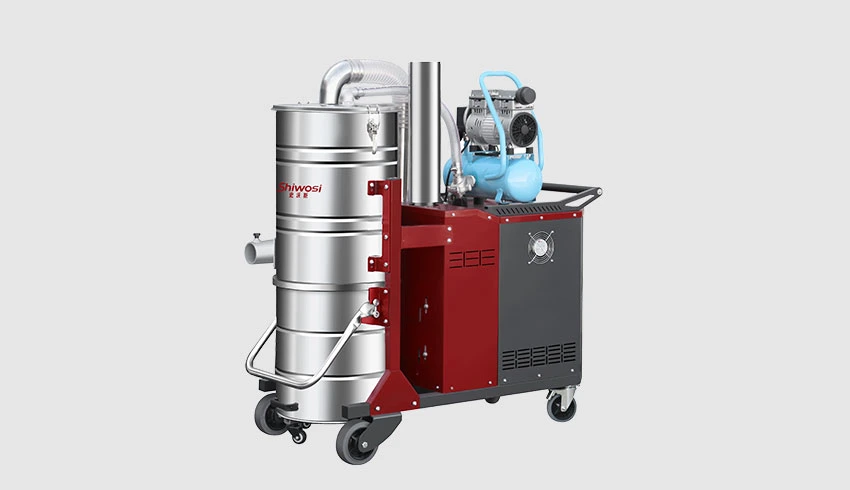

Metal chips, coolant-soaked swarf and fine grinding dust are different collection tasks. Choosing an industrial vacuum cleaner for a machine shop starts with identifying the material and the job, then checking the complete collection system: nozzle, hose, separator, filter, container and power supply.
For coarse chips, examine the collection path and unloading method. For chips mixed with coolant, confirm liquid compatibility and separation. For fine dust, establish the filtration and hazard requirements before comparing models. Motor power alone cannot answer these questions.
Published by SHIWOSI. Sources checked on October 26, 2026.
This guide provides a purchasing framework for workshop housekeeping, using the SHIWOSI operating manuals and the safety sources linked below. It is not a comparative product test or a design specification for process extraction.
1. Define what the vacuum will collect
Write a separate requirement for each waste stream. A machine that handles floor debris may not be suitable for grinding dust or coolant-tank cleaning.
| Collection task | What to establish | What to ask the supplier |
|---|---|---|
| Coarse machining chips | Material, shape, temperature and quantity | Can representative chips pass through the nozzle, hose and inlet without repeated blockage? |
| Chips mixed with coolant | Fluid identity, solids loading and disposal route | Is the quoted configuration approved for that fluid, and how are chips separated from liquid? |
| Fine machining or grinding dust | Composition, exposure hazards and combustibility | Which filtration and complete-machine requirements apply to this material? |
| Repeated cleanup across several machines | Collection frequency, travel distance and available utilities | What operating limits, emptying intervals and maintenance access does the installation require? |
Include a sample or clear photographs of the waste. Long, curled swarf and short chips of the same metal can create different handling problems. Do not assume that suitability for one alloy or process extends to another.
Check dust hazards before selecting equipment
Large metal pieces and fine metal dust do not behave the same way. OSHA notes that materials such as aluminum or iron can present explosion hazards in dust form under the right conditions. See OSHA's combustible dust overview.
If combustible dust or a classified location is involved, have the site's competent safety specialist establish the collection requirements. Ask for documentation covering the exact machine, accessories, material and intended use. A HEPA filter, metal tank or “explosion-proof” product name alone does not establish suitability for the application.
2. Separate chip collection from coolant management
A wet-and-dry label is a starting point, not confirmation that a vacuum can handle every cutting fluid or recover coolant for reuse.
Provide the supplier with the fluid's safety data sheet, working concentration, expected temperature and approximate liquid volume. Confirm compatibility of the seals, hose, container and liquid-handling components, together with the required overfill protection and discharge method.
For mixed chips and liquid, ask whether a removable basket or other separator is included. Check how the operator will remove it when loaded, where the liquid drains and how the material reaches the waste container. A large nominal tank is less useful if unloading is awkward or exceeds the site's handling limits.
Keep recovered liquid separate from unrelated floor-cleaning waste. CCOHS advises against putting floor wash water or other waste into metalworking-fluid sumps and coolant return trenches. Its metalworking fluids guidance also explains why fluid composition and contamination matter.
Recovering liquid does not establish that it is suitable for reuse. Follow the site's fluid-management procedure and the coolant supplier's acceptance criteria.
3. Compare performance at the working configuration
Airflow, vacuum pressure and motor power describe different aspects of performance. Treat them as inputs to a selection decision rather than competing headline numbers.
Airflow: ask for performance with the proposed hose, nozzle and filtration arrangement.
Vacuum pressure: ask how the system performs with the resistance of the intended collection path.
Motor power: confirm the electrical requirements and operating limits of the exact configuration.
Maximum airflow and maximum vacuum are not normally the same operating point. Ask for a performance curve or a demonstration under representative conditions instead of comparing the two maxima as if they occur together.
For metal chips, pay particular attention to restrictions: a narrow nozzle, tight bend or reduced inlet can become the point where swarf accumulates. Specify hose length and diameter in the quotation. A demonstration with a short hose does not establish performance through the longer hose used on your shop floor.
4. Match filtration and cleaning to the waste
Coarse chips and fine dust place different demands on filtration. Ask the supplier to identify the filter configuration, replacement procedure and evidence supporting any filtration classification claimed for the complete machine.
A micron figure on a specification sheet does not, by itself, describe collection efficiency, leakage or suitability for a hazardous material. Where a particular dust class or filtration standard is required, request the relevant documentation rather than inferring compliance from filter media alone.
Filter-cleaning arrangements also affect the work routine. Manual cleaning requires an operator intervention; automatic cleaning changes how that intervention is managed. Neither arrangement removes the need to inspect filters, seals and collection components.
For a documented example, the SHIWOSI X8 manual lists manual reverse blowing in its specification table (printed page 12; PDF page 15). The X9 manual lists pulse reverse blowing on the corresponding specification page. Its operating instructions identify a pulse switch for activating the device (printed page 7; PDF page 10). These descriptions establish a difference in the cleaning arrangements; they do not establish unattended automatic cleaning or continuous operation.
See the X8 operating manual, specification page and X9 operating manual, operation page. Match the model designation in the manual to the exact configuration being quoted.
The X9 manual's cautions also identify special equipment requirements for toxic, flammable, explosive or corrosive materials (printed page 2; PDF page 5). Do not extend a standard configuration's collection scope to these materials without application-specific confirmation. For current model enquiries, see the X8 product page and X9 product page.
5. Define what “continuous operation” means for your shop
Tell the supplier whether the vacuum will run for a short cleanup, serve several machines in succession or operate for extended periods. Request written operating limits for the exact motor, electrical supply and application.
Also account for stops to empty the container, clear obstructions and service the filter. Automatic filter cleaning does not establish a continuous-duty rating or guarantee uninterrupted collection. If pulse cleaning requires compressed air, include the air supply requirements in the installation review.
A practical comparison should cover the whole shift: operator time, unloading, consumables, maintenance access and spare-parts availability, as well as purchase price.
6. Use a representative acceptance trial
Before committing to a configuration, agree on a trial using waste that represents the intended application and has been assessed for safe handling. This is a proposed evaluation method, not a report of testing performed by SHIWOSI.
Record the following:
Material identity, chip shape, liquid content and starting quantity.
Machine configuration, hose length, nozzle, power supply and any air supply.
Collection time, blockages and operator interventions.
Filter-cleaning stops, unloading time and any material left in the collection path.
Inspection findings, including leaks or visible emissions, and any further checks required by the site's risk assessment.
Agree on acceptance criteria before the trial. Absence of visible dust does not prove that airborne exposure limits are met. A pickup demonstration also does not establish explosion protection, filtration certification or coolant-reuse quality.
Questions buyers often ask
What is the best industrial vacuum for metal chips?
The best fit depends on chip shape, alloy, liquid content, quantity and unloading requirements. Start with those conditions and compare documented configurations. A single horsepower or tank-capacity figure cannot identify a universal winner.
Can one vacuum collect both chips and coolant?
Possibly, if the complete configuration is approved for the specific fluid and solids. Confirm compatibility, separation, overfill protection and emptying arrangements in writing. Keep incompatible waste streams separate.
Can a housekeeping vacuum replace extraction at a grinding machine?
Do not assume so. Picking up settled material and controlling airborne contaminants at their source are different tasks. Process extraction needs an assessment of the machine, emission source and required controls.
Prepare a useful equipment enquiry
Send the material or alloy, waste photographs, coolant safety data sheet if relevant, estimated collection quantity, operating schedule, hose reach, voltage and frequency, and destination country. Include any dust-hazard assessment or required equipment classification.
Use these details to request a configuration-specific recommendation and supporting documents. You can compare the SHIWOSI industrial vacuum range or contact SHIWOSI with your application requirements. Confirm the material-handling scope and acceptance criteria before ordering.